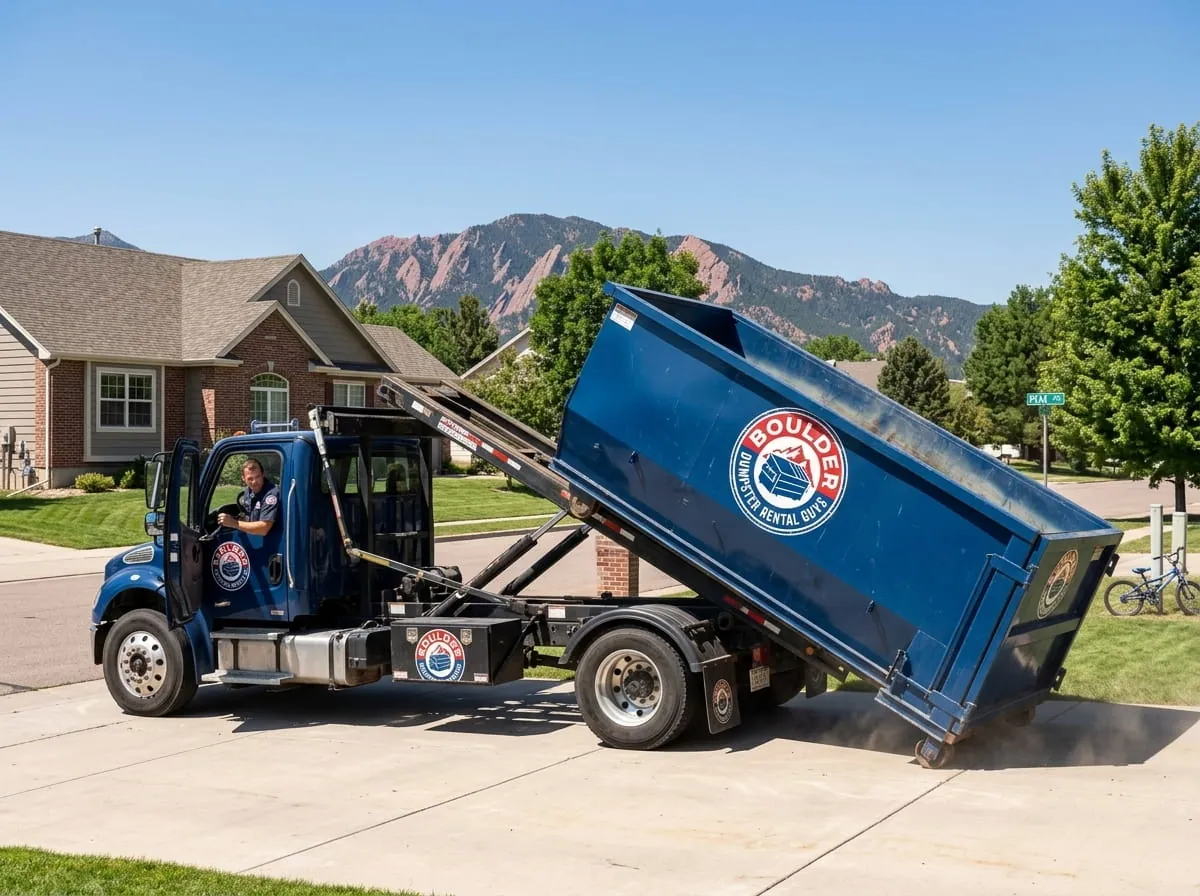
If you've owned a house on the Front Range for more than a couple of summers, you already know the drill. A storm rolls off the foothills in July, the sky goes green, and twenty minutes later your neighbor's yard is full of ice the size of golf balls. Two weeks after that, half the block has ladders leaning against the eaves and roofing crews crawling around at seven in the morning. Boulder County is one of the hardest-hit hail corridors in the country, and roof replacement here is less a home-improvement project than a fact of life.
I've been dropping dumpsters for tear-offs in this area long enough to have watched a lot of homeowners get the sizing wrong. Not because they're careless, but because roofing debris behaves nothing like the garage cleanout or the deck demo they're picturing. Shingles are deceptively, brutally heavy. Order the wrong container and you either pay for air you didn't use or, worse, overload a can that legally can't leave your driveway. So let's walk through how to think about this the way a crew does.
Why roofing debris is so heavy
Here's the thing people miss: a cubic yard of loose cardboard weighs almost nothing, but a cubic yard of asphalt shingles can run 400 pounds or more. Shingles are basically a fiberglass or felt mat soaked in asphalt and topped with mineral granules. They're designed to shed water and survive decades of Colorado sun, which means they're dense, and they stack flat with very little wasted space. When a crew rips them off and they pancake into a dumpster, you get an enormous amount of weight in a small footprint.
The standard unit roofers use is the "square" — 100 square feet of roof coverage. For estimating disposal, a rough rule that's served me well: one square of standard three-tab asphalt shingle weighs somewhere between 220 and 260 pounds when you're pulling it off. Architectural or "dimensional" shingles, the thicker laminated kind most Boulder homes have gone to, run heavier — call it 350 to 450 pounds per square. And that's for a single layer.
The shingle weight math
Let me make this concrete, because the arithmetic is what actually protects your wallet. Say you've got a modest ranch with about 20 squares of roof — that's 2,000 square feet of coverage. One layer of architectural shingle at 400 pounds a square is 8,000 pounds. Four tons. And that's before you add the tear-off extras: old felt paper, drip edge, a few sheets of rotted decking, the pile of bent nails, maybe some pipe boot flashing. Realistically you're looking at four and a half to five tons of debris off a single-layer, single-story ranch.
Now here's where people get burned. If that same roof has two layers — an older shingle roof that a previous owner just went over instead of tearing off — you double the shingle weight. Suddenly your 20-square ranch is throwing eight tons of asphalt into the can, plus the extras. That is a genuinely large load, and it changes the whole conversation about what container you need and how many times we have to come swap it.
Single layer versus multi-layer: check before you order
Before you call anybody, figure out how many layers are up there. Older Boulder and Longmont homes, especially anything built or re-roofed in the seventies and eighties, frequently have two or even three layers stacked up. Code caught up eventually — most jurisdictions now cap you at two layers and require a full tear-off beyond that — but the legacy is still sitting on a lot of roofs.
You can usually tell by looking at a gable edge or lifting a shingle near the rake. If you see one course of shingle and then decking, you're single-layer. If you see shingle, then more shingle, then paper, you've got a multi-layer situation and you need to plan for roughly double the tonnage. Tell whoever you rent from. A good operator will size the weight allowance and the swap schedule around that number instead of guessing.
The 10-to-15 yard sweet spot
Now the part everyone asks about: what size do I get? For the vast majority of residential tear-offs on the Front Range, the answer lives in the 10-to-15 yard range, and there's a specific reason it's not bigger.
With light material like household junk, people naturally want the biggest box they can get. Roofing flips that instinct on its head. Because shingles are so heavy, you will hit the container's weight limit long before you fill it to the top. A 20 or 30 yard roll-off looks generous, but if you load it with shingles you'll max out the axle weight with the box only a third full — and now it can't legally roll down the road. So we cap roofing loads by weight, not by volume, and a smaller, purpose-sized can is actually the smarter tool.
A 15-yard dumpster is the workhorse for this job. It handles a typical single-layer roof up to around 25 or 30 squares in one drop, its lower walls make it easy for a crew to toss debris over the side or run it down a slide, and it sits nicely on a standard driveway without eating the whole thing. For a smaller single-layer roof, or a garage and shed, a 10-yard does the job. When you get into big two-layer tear-offs or steep multi-story roofs with a lot of squares, we'll usually plan on a 15-yard with a swap partway through rather than one oversized can that can't be legally hauled full.
If you want the operator's honest shorthand: order for weight, keep the box on the smaller side, and plan a swap if the numbers say so. That beats a giant dumpster you can only half-fill every time.
Not sure how many squares or layers you're dealing with? Call Boulder Dumpster Rental Guys at (970) 601-7836 and we'll help you run the numbers before you commit to a size.
The Colorado hail-damage angle
I want to spend real time here because it's the single biggest driver of roof work in our area, and it changes the logistics. When a hailstorm hits Boulder, Louisville, Erie, or up toward Longmont, it doesn't damage one roof — it damages a whole zip code at once. Insurance adjusters flood in, claims get approved in waves, and every roofing company in a fifty-mile radius books solid for months.
What that means for you: dumpsters get tight fast after a big storm. The same week your claim gets approved, ten thousand other homeowners got theirs approved too, and everybody needs a container in the same narrow window. If you know a storm hit your neighborhood and you've filed a claim, get on the phone about a dumpster early — even before the crew is scheduled — so you're not the house waiting three weeks for a can while your approved timeline burns.
There's a money angle too. Hail replacements are almost always insurance jobs, which means disposal is a documented line item. Keep your dumpster receipt and the weight tickets. If you're managing the project yourself rather than going through a full-service roofer, that paperwork matters when you're squaring up with the adjuster. And because these are insurance-driven, they tend to be full tear-offs down to the deck — adjusters generally won't pay to lay another layer over storm-damaged shingles — so budget for the heavier full-removal tonnage, not a light overlay.
Driveway placement done right
Where the box sits matters more on a roofing job than almost any other. You want it as close to the section of roof being worked as you can get it, because every foot a laborer has to carry or wheelbarrow shingle debris is time and money. A can parked right below the eave lets a crew rake tear-off straight over the edge into the box. That's the ideal.
Protect your driveway. A loaded roofing dumpster is heavy, and the wheels and the delivery truck concentrate a lot of that weight on small contact points. Ask for boards under the wheels — most good operators, us included, will set the can down on planks to spread the load and keep the coating on your concrete or asphalt from cracking or scarring. If your driveway is newer or you're precious about it, say so up front.
Mind the overhead too. Delivery trucks lift the box high to set it down, so we need clear sky — no low power lines, no big overhanging cottonwood limbs, no basketball hoops in the swing path. Give us a heads-up on gates, tight turns, or an HOA that gets fussy about where a container can sit and for how long. A two-minute conversation beforehand saves a headache on drop day.
Swaps and hauling the load out
For bigger roofs, one dumpster often isn't enough — not because it fills up, but because it hits weight. When that happens we do a swap: haul the full can to the transfer station, dump it, and bring it back empty, or drop a fresh one and take the loaded one away. On a large two-layer tear-off we plan the swap into the schedule so the crew never stops working while the box is out.
Timing is everything on a roofing swap. Crews move fast — a good team can strip a whole roof in a day — so if you need a mid-job swap, tell us the morning of, not at four in the afternoon when the box is already mounded over. Give us the call while there's still daylight and truck availability, and we'll keep you rolling. For most single-layer residential jobs, though, one correctly sized 15-yard drop covers the whole thing start to finish.
Roofing is one of those jobs where a little planning up front removes almost all the friction. Know your squares, count your layers, size for weight, park it close, and line up a swap if the math calls for one. If you want a hand thinking any of that through — or you just got a hail claim approved and need a can before the rush — reach out through our contact page or ask us about roofing dumpster rental and we'll get you set up right.

Founder, Boulder Dumpster Rental Guys — sharing straight advice from more than 15 years of local hauling experience.
Frequently Asked Questions
What size dumpster do I need for a roof tear-off in Boulder?
For most residential tear-offs, a 10-to-15 yard dumpster is the sweet spot. Because shingles are so heavy, you hit the weight limit long before you fill a big box, so a 15-yard handles a typical single-layer roof of 25 to 30 squares. Larger two-layer roofs usually take a 15-yard plus a mid-job swap.
How much does a roof's worth of shingles weigh?
Standard three-tab shingle runs about 220 to 260 pounds per square (100 square feet), and thicker architectural shingle runs 350 to 450 pounds per square. A single-layer 20-square ranch typically throws four and a half to five tons of debris once you add felt, decking, and nails. Two layers roughly doubles that.
How do I know if my roof has one layer or two?
Look at a gable or rake edge and lift a shingle. If you see one course of shingle and then decking, it's single-layer. If you see shingle over shingle over paper, it's multi-layer and you should plan for roughly double the tonnage. Tell your dumpster company the layer count so they can size the weight allowance correctly.
Will a roofing dumpster damage my driveway?
It can if it's set down bare, because a loaded roofing can concentrates a lot of weight on small contact points. Ask for boards under the wheels — we set the container on planks to spread the load and protect your concrete or asphalt. Also keep the drop spot clear of low power lines and overhanging branches.
Should I book a dumpster before or after a hailstorm claim is approved?
Book early. A big Front Range hailstorm damages an entire zip code at once, so roofers and dumpsters both get tight within days of claims being approved. Get on the phone about a container as soon as you know you're replacing the roof, and keep your weight tickets and receipt for the insurance adjuster.